Fun Water Activities in Bali for You to Try or Re-Try
Bali is not only about temples, sunsets, and beach clubs. It is also one of the best destinations in Indonesia for thrilling water sports, family-friendly sea adventures, and unforgettable coastal experiences.
Looking for the best fun water activities in Bali? This guide covers the top Bali water sports for couples, families, and adrenaline lovers, from jet ski and parasailing to flyboard, banana boat, sea walking, stand up paddle, and wakeboard.
Good to know before you start: warm up before each session, stay hydrated, listen carefully to the instructor, and always wear the recommended safety gear.
Top Destinations for Fun Water Activities in Bali
1. Tanjung Benoa
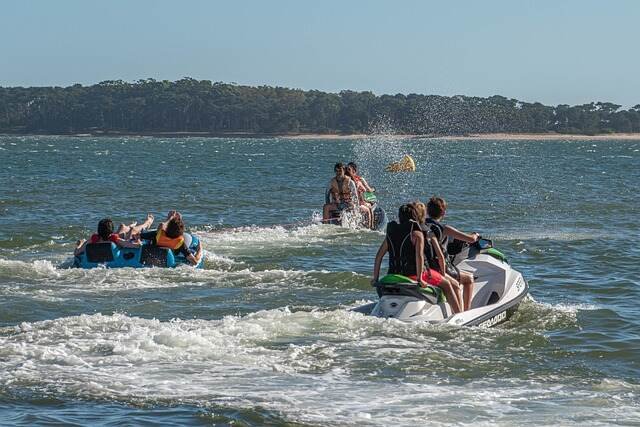
Tanjung Benoa is the classic hub for Bali water sports. It is one of the best places for jet ski, banana boat, parasailing, fly fish, and flyboard.
There’s nothing quite like cruising across the water in Tanjung Benoa! If you’re heading to Bali, riding a jet ski here is an absolute must. Just a heads up—an instructor usually rides along with you for safety, but it’s still an awesome rush! Pinterpandai.com, CC BY-SA 3.0, via Wikimedia Commons
2. Nusa Dua
Looking for quiet water sports in Nusa Dua? While high-speed jet skis and motorized rides take place next door in Tanjung Benoa, Nusa Dua’s calm beaches are perfect for ocean kayaking and stand-up paddleboarding! You can easily rent kayaks right on Mengiat Beach or at most beachfront resort water sports desks.
3. Sanur
Are you looking for quieter water sports in Bali? While high-speed jet skis and motorized rides take place next door in Tanjung Benoa, Nusa Dua’s calm, sheltered beaches are ideal for ocean kayaking, canoeing, and stand-up paddleboarding (SUP).
Furthermore, visitors can easily rent non-motorized water sports gear right on Mengiat Beach or directly at beachfront resort desks along the main strip.
These islands are famous for snorkelling, diving, island boat trips, and marine adventures.
Located just off Bali’s southeastern coast, these neighboring islands are world-famous for world-class snorkeling, scuba diving (including manta ray spots), island boat trips, and immersive marine adventures.
Bali to Komodo
Labuan Bajo • Padar • Pink Beach
Dragons • Diving • Island Hopping
From Bali to Komodo Island: Complete Travel Guide
Traveling from Bali to Komodo is one of Indonesia’s most unforgettable journeys.
In a relatively short journey, you move from Bali’s temples and beaches to a wild
archipelago of pink beaches, rugged hills, extraordinary diving sites and the legendary
Komodo dragons.
This guide explains how to travel from Bali to Labuan Bajo, how to choose a Komodo boat
tour, what to see inside Komodo National Park, and how to prepare for the trip.
Komodo National Park combines wildlife, trekking, island hopping, snorkeling,
diving and dramatic coastal landscapes in one destination.
The region is known for pink beaches, dry volcanic ridges, turquoise water,
coral reefs and the famous Komodo dragon.
The national park includes the major islands of Komodo, Rinca and Padar, together with many smaller islands,
beaches and reef systems.
Komodo National Park is internationally recognized for its exceptional
wildlife, landscapes and marine environment.
The islands are generally much drier than Bali. During the dry season, the hills
often become golden and create a striking contrast with the blue sea.
Location
Where Is Komodo National Park?
Komodo National Park lies in East Nusa Tenggara, between the islands of Sumbawa
and Flores.
Labuan Bajo, on the western side of Flores, is the principal gateway for boat
tours into the park.
Komodo Dragons
Komodo dragons live on several islands and areas within the region, including
Komodo, Rinca, Gili Motang and parts of Flores.
Visitors normally see the animals during ranger-led walks on designated routes.
Sightings are natural and cannot be guaranteed because the dragons are wild.
Getting there
How to Travel from Bali to Komodo Island
The most common route is to fly from Ngurah Rai International Airport, code DPS, to Komodo Airport in Labuan Bajo, code LBJ.
Typical direct flying time: approximately 1 hour 10 minutes
to 1 hour 30 minutes, depending on the flight.
After landing: Transfer to Labuan Bajo and join a boat trip
into Komodo National Park.
Labuan Bajo: Gateway to Komodo National Park
Labuan Bajo is the main departure point for Komodo boat tours and liveaboard cruises.
It is worth spending at least one night in town. Labuan Bajo offers a harbour,
sunset viewpoints, hotels, restaurants, dive centres and access to nearby islands.
Flying from Bali to Labuan Bajo
Flying is the easiest choice for most travelers because it saves considerable time
compared with travelling by sea.
Departure airport: Bali, DPS
Arrival airport: Labuan Bajo, LBJ
Best for: Families, couples and visitors with limited time
Next step: Hotel transfer or direct transfer to the harbour
Reaching Flores by sea is possible, but it normally takes much longer than flying.
Public ship schedules may change and onboard comfort varies.
Check current public ship information through
PELNI .
Choosing a Komodo Boat Tour
From Labuan Bajo, the main tour options are:
Speedboat day trip: Fastest but usually rushed
Two-day cruise: More time for sightseeing and snorkeling
Three- or four-day liveaboard: More relaxed and immersive
Private charter: Flexible but normally more expensive
A longer cruise often provides more time for sunrise hikes, quieter snorkeling
stops and relaxed travel between islands.
Boats at Pink Beach in Komodo National Park. Photo:
Jakub Hałun
via Wikimedia Commons under
CC BY 4.0 .Fees and permits
Komodo National Park Fees and Permits
Park fees, activity fees and entry procedures can change. Avoid relying on an
old fixed price published in a travel article.
Confirm the current charges with the official permit system and your boat operator
before departure.
Official Permit Information
Check current permit information through
SiORA SIMAKSI .
The SiORA application is also available through the
Apple App Store .
What Charges May Include
National park entry
Conservation charges
Ranger or guide services
Trekking permits
Snorkeling or diving activity fees
Other destination-specific charges
Some boat packages include part or all of the required fees, while others exclude
them. Request a written breakdown before paying.
Things to do
Best Things to Do in Komodo National Park
Komodo National Park offers much more than dragon viewing. A typical journey
combines wildlife, hiking, beaches, coral reefs and dramatic island scenery.
Hike to the Padar Island viewpoint.
See Komodo dragons with a ranger.
Snorkel over coral reefs.
Look for manta rays in suitable conditions.
Relax and snorkel at Pink Beach.
Watch the sunrise or sunset from the boat.
Visit small islands and sandbanks.
Scuba dive with an experienced operator.
1. Hike to the Padar Island Viewpoint
Padar Island is famous for one of Indonesia’s most recognizable panoramas.
The trail climbs above several curved bays and contrasting beaches.
The route includes a substantial number of steps and exposed uphill sections.
Conditions can feel demanding in tropical heat even though it is not a technical hike.
Padar Island, Komodo National Park: A spectacular panorama from the island’s southern viewpoint, showcasing its iconic rugged hills, dramatic volcanic coastline, and distinct white, pink, and black sand bays. Jakub Hałun, CC BY 4.0, via Wikimedia Commons
Wear secure shoes, take drinking water and use sun protection. Early morning
generally offers cooler conditions.
2. Visit Pink Beach
Pink Beach is known for sand that can appear pink because of the combination
of pale sand and small red-toned marine fragments.
Pink Beach, Padar Island: Famous for its rare rosy sands—created by microscopic red organisms mixing with white coral—set against clear turquoise waters and the dramatic hills of Komodo National Park. Jakub Hałun, CC BY 4.0, via Wikimedia Commons
Visitors come to swim, rest on the beach and snorkel in the surrounding water.
The strength of the colour varies according to sunlight, weather and beach conditions.
Do not remove sand, coral or shells from the protected area.
3. Snorkel at Manta Point
Manta Point is a well-known location where visitors may encounter manta rays.
Sightings depend on tides, currents, weather and natural animal movement.
Manta Point, Komodo National Park: A majestic manta ray gliding effortlessly through the water, filtering plankton by swimming against the ocean current in the marine reserve. Siharaditia, CC BY-SA 4.0, via Wikimedia Commons
The water can have strong currents. Enter only when the crew considers conditions
safe, remain close to your guide and never chase or touch the animals.
4. See Komodo Dragons with a Ranger
Komodo dragons are wild predators and must be viewed under the supervision of
authorized rangers or guides.
Dragon-viewing walks are commonly organized on Komodo or Rinca Island. The exact
route depends on park rules, conditions and the chosen tour.
Komodo Dragons with a Ranger: Visitors exploring Komodo National Park alongside a certified park ranger, ensuring safe encounters with the world’s largest living lizard in its natural wild habitat. P. Hughes, CC BY 4.0, via Wikimedia Commons
Adult dragons can reach approximately 3 metres (9.8 ft) in length. Visitors must keep
a safe distance and follow every ranger instruction.
Is It Dangerous to Visit Komodo?
Komodo dragons are potentially dangerous wild animals. A visit can be managed
safely when travelers remain with authorized rangers and follow park instructions.
Stay with your ranger and group.
Keep the required distance from every dragon.
Do not feed or approach wildlife.
Avoid sudden movements.
Tell the ranger immediately about cuts or bleeding.
Supervise children closely.
Do not leave designated routes.
Itinerary
Sample Four-Day Bali-to-Komodo Itinerary
Day 1: Fly from Bali to Labuan Bajo
Fly from Bali to Labuan Bajo. Transfer to your accommodation and use the
afternoon to explore the harbour or prepare for the boat trip.
Confirm the departure time, included fees, meals, equipment and luggage rules
with the operator.
Day 2: Begin the Komodo Boat Trip
Board your boat and begin exploring the national park. Depending on the itinerary,
the day may include Rinca Island, snorkeling locations and a sunset stop.
Day 3: Padar Island, Pink Beach and Manta Area
Start early for the Padar Island hike. Continue to Pink Beach and, when sea
conditions permit, visit a manta-ray area with your guide.
Day 4: Return to Labuan Bajo
Enjoy final snorkeling or island stops before returning to Labuan Bajo.
Spend another night in town or take a later flight when the schedule provides
enough connection time.
Important: Avoid booking a flight too close to the planned
boat-return time. Weather and sea conditions can delay arrival in Labuan Bajo.
What is the fastest way to get from Bali to Komodo?
The fastest route is to fly from Bali, airport code DPS, to Labuan Bajo,
airport code LBJ. From Labuan Bajo, join a boat tour into Komodo National Park.
Do I need a guide to see Komodo dragons?
Yes. Visitors must follow authorized rangers or guides on designated
dragon-viewing routes.
Do I need the SiORA application?
Permit procedures can change. Check the official SiORA system and ask your
tour operator which registrations or permits are required before departure.
When is the best time to visit Komodo?
The drier months are often preferred for island hopping and hiking. However,
weather, waves and underwater conditions vary throughout the year. July and
August are commonly busy travel periods.
Is Komodo suitable for families?
Komodo can be suitable for families, depending on the children’s ages, swimming
ability and the chosen boat. A private trip or shorter cruise can provide more
flexibility.
Can I visit Komodo as a day trip from Bali?
A same-day trip may be technically possible with certain flight and speedboat
schedules, but it is tiring and leaves little protection against delays.
Staying in Labuan Bajo is normally more practical.
How many days should I spend in Komodo?
Allow at least two or three days in the national park when possible.
A three- or four-day cruise provides a more relaxed experience than a single
speedboat day trip.
Kelor Island Viewpoint: A scenic hilltop look over the west coast of Flores in Komodo National Park, showcasing turquoise shallows, wooden boat docks, and rolling mountain landscapes. Jakub Hałun, CC BY 4.0, via Wikimedia Commons
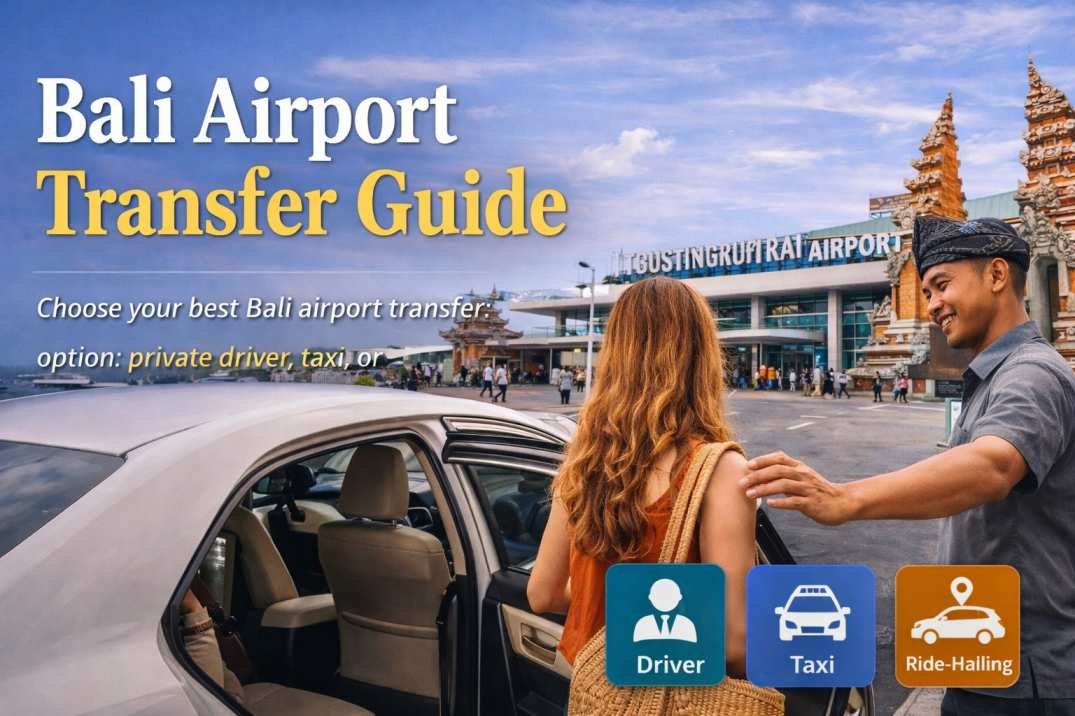
This Bali airport transfer guide explains the best ways to travel from Ngurah Rai International Airport (DPS) to Seminyak, Ubud, Canggu, Sanur, Uluwatu, Nusa Dua, Jimbaran and other popular Bali areas. You can compare estimated prices, distances in kilometers and miles, travel times, Grab airport pickup, Official Bluebird Taxi, Traveloka airport transfers and private drivers before you arrive.
What is the best Bali airport transfer option?
For most travelers, a pre-booked private airport transfer is the easiest option because your driver can be arranged in advance and the arrival process is more relaxed. If you prefer app-based transport, Grab has a dedicated airport pickup flow and a specific airport pickup area at DPS.
If you want an on-site option, the official airport website also lists official transport services available at the airport.
Quick recommendation
Best for convenience: private airport pickup
Best app-based option: Grab airport pickup (like Uber)
Best if you want airport-based help: official airport transport desk or listed airport service
If you are arriving late, traveling with children, or carrying a lot of luggage, pre-arranging your ride is usually the smoothest choice.
Important pricing disclaimer:
Bali airport transfer prices are estimated averages for 2026. However, prices may change depending on traffic, weather, airport fees, fuel prices, luggage, public holidays, booking platform surcharges, vehicle type and seasonal demand.
Is Grab Available at Bali Airport?
Yes. Grab (like Uber) officially operates at Ngurah Rai International Airport (DPS). In addition, the app provides airport pickup guidance and dedicated pickup areas for travelers.
Yes. Bluebird Taxi is considered one of the safest and most trusted taxi companies in Bali because drivers use official meters and standardized pricing.
Usually, yes. Pre-booking your airport transfer can reduce stress after a long flight, especially for families, villa stays, late-night arrivals and travelers carrying large luggage.
In addition, booking in advance helps travelers compare prices between Grab, Traveloka, private drivers and metered taxis before arriving in Bali.
Bali Airport Transfer FAQ
How much is a taxi from Bali Airport to Ubud?
Taxi and private transfer prices from Bali Airport to Ubud usually range between IDR 350,000 and IDR 700,000 depending on traffic and vehicle type.
How much is a taxi from Bali Airport to Seminyak?
Taxi prices from DPS Airport to Seminyak generally range from IDR 150,000 to IDR 450,000 depending on traffic and transfer type of car.
What is the cheapest airport transfer option in Bali?
Grab airport pickup is often one of the cheapest transportation options from Bali Airport. However, prices can rise during peak traffic or high-demand periods.
Should I pre-book my Bali airport transfer?
Yes. Pre-booking your airport transfer is recommended, especially for families, late-night arrivals and villa stays.
How far is Ubud from Bali Airport?
Ubud is approximately 35–40 km (22–25 miles) from Ngurah Rai Airport. Usually, the journey takes between 1.5 and 2.5 hours depending on traffic.
Common mistakes to avoid
Landing without mobile data or a working eSIM
Not saving the pickup point or driver contact details
Trying to decide transport only after leaving the terminal
Using unofficial pickup arrangements without clear confirmation
Not checking where your app-based pickup point is located
Best choice by travel style
Best for families: private airport pickup
Best for app users: Grab airport pickup
Best for easy airport guidance: official airport transport service
Best for villa arrival comfort: pre-arranged direct transfer
Best SIM Card for Bali 2026: eSIM, Tourist SIM and Airport Options
Need mobile data as soon as you land in Bali? This guide compares eSIM, tourist SIM, and local provider options so you can choose the easiest setup for your trip.
The best SIM card for Bali depends on how you travel. If you want the fastest setup, an eSIM is usually the easiest because there is no physical card to install. Telkomsel officially offers eSIM, XL sells SIM and eSIM through XL Store, and IM3 also has an official eSIM page plus a Visiting Indonesia offer. Telkomsel also says foreigners can pre-order a Tourist Prepaid Card and pick it up on arrival or buy it at selected stores.
What is the best option for most travelers?
For most visitors, eSIM is the most convenient choice because it can be activated without swapping a physical card. Telkomsel and IM3 both have official eSIM pages, and XL also sells eSIM through its official store.
If your phone does not support eSIM, a physical tourist SIM is still a practical option. XL’s tourist SIM flow specifically asks visitors to prepare a passport, email, and device ID or IMEI during the process.
Quick recommendation
Best for convenience: eSIM
Best if you want a local tourist setup: Tourist SIM
Best if you want to arrange before arrival: Telkomsel Tourist Prepaid pre-order or a travel eSIM
Airalo also offers Indonesia eSIM packages, which can be useful if you prefer a travel eSIM app before landing, but network quality depends on the underlying local partner network.
Best SIM card for Bali comparison
Telkomsel
Official eSIM is available, and Telkomsel’s FAQ says foreigners can buy a Tourist Prepaid Card by pre-ordering online for pickup on arrival or by purchasing directly at selected stores or GraPARI outlets.
Best for: travelers who want an official tourist-friendly option with pre-arrival flexibility.
Generally the most expensive. Because it has the largest infrastructure, its prices are higher, with 25GB tourist plans typically starting at IDR 150,000 (~$9.60 USD)
XL
XL sells SIM and eSIM through its official store, and its tourist SIM process specifically mentions passport, email, and device ID or IMEI requirements.
Best for: travelers who want a local physical SIM or eSIM with an official tourist registration flow.
Positions itself as the “value” mid-range choice. It is often cheaper than Telkomsel but slightly more expensive than IM3, with a very competitive 150GB plan for around IDR 150,000–200,000 (~$9–$12 USD).
IM3
IM3 has an official eSIM page and an official Visiting Indonesia product page aimed at inbound travelers.
Best for: travelers who want another local option with official eSIM support.
Often the cheapest for “Freedom” or “Travel On” data bundles. For example, 30GB plans can be found for around IDR 100,000 (~$6.40 USD).
How to choose the best SIM card for Bali
1
Check if your phone supports eSIM
If it does, eSIM is usually the smoothest option because you can activate service without inserting a physical card.
2
Decide if you want a local number
A tourist SIM may be better if you prefer a local number and in-person setup after arrival.
3
Prepare your documents
For tourist registration, providers may ask for passport details, email, and device information such as IMEI. XL explicitly lists these in its tourist SIM flow.
4
Use official provider pages
It is safer to buy through official pages or official stores because package names, activation steps, and requirements can change.
5
Save setup details
Before leaving the airport, make sure your mobile data works and save your number, QR code, or activation email.
6
Keep a backup option
If your phone is not eSIM compatible, a physical SIM or a second travel eSIM provider can be a useful fallback.
Smart travel tip: set up your SIM or eSIM before booking airport pickup, using maps, or contacting your villa. Mobile data is one of the first things you will need after landing in Bali.
Airport SIM or eSIM before arrival?
If you want the easiest arrival, setting up an eSIM before you fly is usually the most efficient choice. If you prefer help in person or need a physical card, a tourist SIM after landing can still work well.
Telkomsel’s official FAQ says foreigners can pre-order a Tourist Prepaid Card for pickup on arrival, which makes it a useful middle-ground option.
Should you use a travel eSIM?
A travel eSIM such as Airalo can be convenient if you want a digital setup before departure. Airalo currently offers Indonesia eSIM packages through its app and website.
The trade-off is that package value and network performance depend on the underlying local partner network, so local official providers can still be a better choice for some travelers.
Common mistakes to avoid
Buying from unofficial pages without checking activation details
Choosing eSIM without confirming your phone supports it
Not preparing passport or registration information
Leaving the airport before testing data and maps
Assuming all providers have the same setup process
Choose the best way to get from the airport to Seminyak.
FAQ
What is the best SIM card for Bali in 2026?
For most travelers, eSIM is the easiest option if the phone supports it. Telkomsel, XL, and IM3 all have official SIM or eSIM options, so the best choice depends on your device and travel style.
Can I buy a tourist SIM before arriving in Bali?
Yes. Telkomsel’s official FAQ says foreigners can pre-order a Tourist Prepaid Card and pick it up on arrival in Indonesia, or buy one at selected stores.
Do I need passport details to buy a tourist SIM?
You may. XL’s official tourist SIM flow specifically says travelers should prepare their passport, email, and device ID or IMEI.
Is eSIM better than a physical SIM for Bali?
Usually yes for convenience, because it avoids swapping a physical card. Telkomsel and IM3 both officially support eSIM, and XL also sells eSIM.
Stay connected from the moment you arrive at Villa Carissa Bali
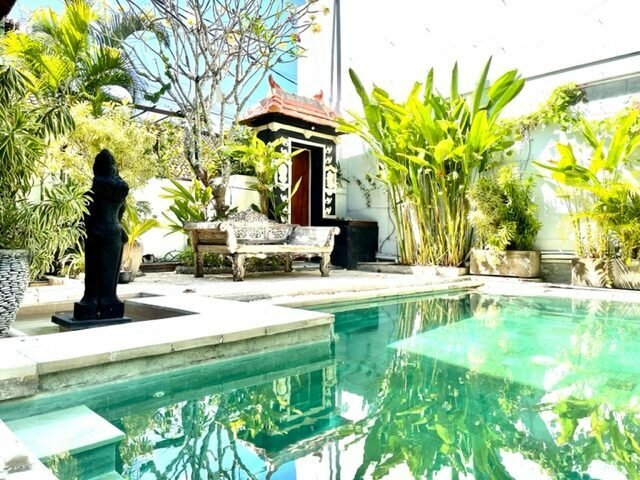
Once your Bali SIM or eSIM is ready, make your stay even easier with a private villa in Seminyak close to restaurants, shopping, beach clubs, and Bali’s most popular areas. Villa Carissa Bali offers a stylish and comfortable base for couples, families, and small groups.
Bali Entry Requirements 2026: Everything You Need Before You Fly
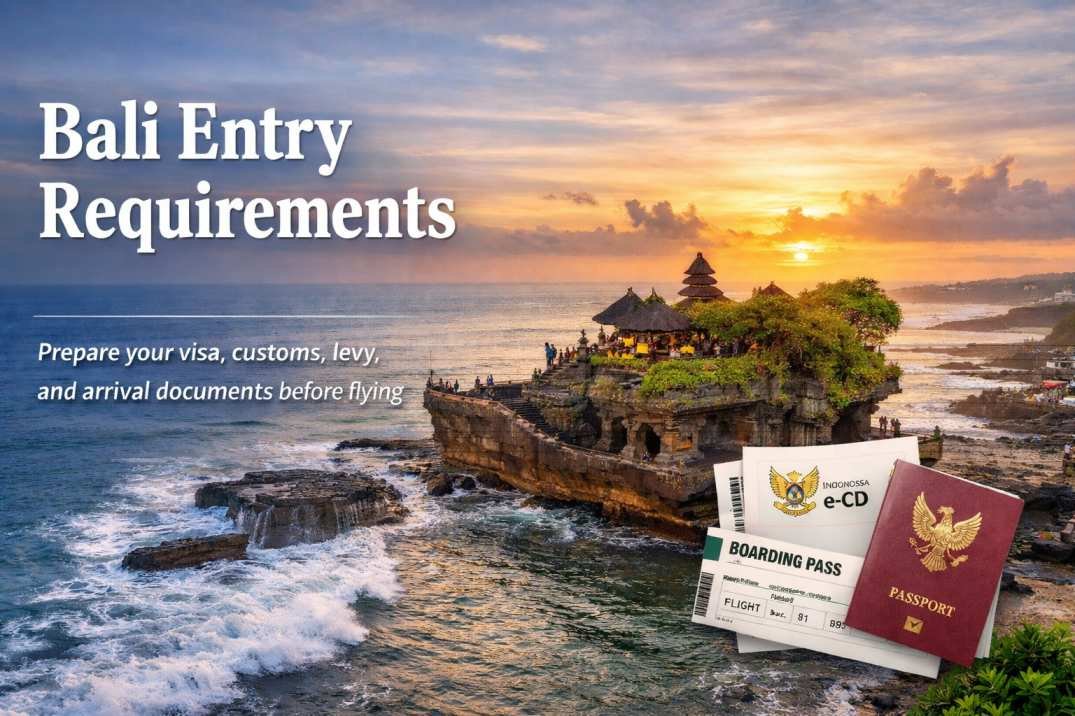
This guide explains the documents and online declarations international
travelers should prepare before flying to Bali, Indonesia.
Learn how to check passport validity, choose the correct visa, complete the
All Indonesia Arrival Declaration, pay the Bali tourist levy and organize
your documents for arrival at Ngurah Rai International Airport.
Bali is part of Indonesia. This means that immigration and visa
rules are set nationally by the Indonesian authorities. Bali also has a separate
provincial foreign-tourist levy.
The exact entry requirements depend on your nationality, passport, reason for
travel and intended length of stay. Do not assume that rules applying to a friend
or previous visit still apply to you.
Before paying for a visa, confirm your eligibility through the official
Indonesian immigration portal. Avoid websites that imitate government pages or
add unnecessary processing fees.
Important: Immigration rules can change. The final authority is
Indonesian Immigration, Indonesian Customs, the Bali Provincial Government and
the airline carrying you to Indonesia.
Bali Entry Requirements Checklist
Use this checklist before traveling. Not every item applies in exactly the same
way to every nationality, so verify your visa category separately.
1
Check Your Passport
Confirm that your passport satisfies the validity requirement for your visa
or entry category. Many Indonesian visitor-visa categories require at least
six months of passport validity.
The passport should be in good condition and the name should match your flight
booking and visa application.
2
Check Your Visa Eligibility
Determine whether you qualify for visa exemption, Visa on Arrival, electronic
Visa on Arrival or another visitor visa.
Eligibility is based primarily on nationality and travel purpose. Check the
official visa list rather than relying on social-media posts.
3
Complete the All Indonesia Declaration
International arrivals must complete the integrated All Indonesia Arrival
Declaration.
The system brings immigration, customs, health and quarantine information
together in one declaration. Save the resulting QR code offline.
4
Pay the Bali Tourist Levy
Foreign tourists visiting Bali are generally subject to the provincial
tourist levy unless they fall within an official exemption.
Keep the payment voucher or QR code accessible on your phone.
5
Prepare Your Onward Ticket
Your airline or immigration officer may ask for evidence that you intend to
leave Indonesia within your permitted stay.
Keep a return or onward booking available offline.
6
Save Your Accommodation Address
Entry forms may ask for the address of your first hotel, resort, guesthouse or
villa.
Save the full name, address, telephone number and booking confirmation.
7
Check Your Baggage and Medication
Review Indonesian Customs and health rules before bringing medication,
commercial goods, large cash amounts, food, plants, animal products or
restricted items.
8
Store Everything Offline
Save screenshots or PDF copies of your visa, declaration QR code, levy
voucher, flight itinerary and accommodation booking.
Do not depend entirely on mobile data or airport Wi-Fi.
Official Bali and Indonesia Entry Links
Use government websites whenever possible. Look carefully at the web address
before entering passport details or making a payment.
Pay the foreign-tourist levy and review official exemptions and FAQs.
Scam warning: A website appearing near the top of a search result
is not automatically an official government site. Check the domain before
submitting passport or payment information.
Passport Requirements for Bali
Your passport is the first document to check. Many Indonesian visitor-visa
categories require a passport that remains valid for at least six months from the
date of arrival.
Check the specific requirement shown for your visa category. Do not calculate the
validity from your planned departure date unless the official rule specifically
tells you to do so.
Your Passport Should Be in Good Condition
Airlines and immigration authorities can raise concerns about passports that are
torn, water-damaged, heavily worn, missing pages or difficult to scan.
Renew the passport before traveling when its condition could reasonably cause a
problem.
Check That All Names Match
Your airline booking, visa application and arrival declaration should use the
same name and passport details.
Recheck the passport number, nationality, date of birth and expiry date before
submitting an online form.
Dual nationals: Use the same passport for your visa application,
airline check-in, arrival declaration and entry into Indonesia.
Do You Need a Visa to Enter Bali?
Bali follows Indonesia’s national visa rules. The answer depends on your
nationality, the purpose of your visit and how long you plan to stay.
Tourist entry can include visa exemption for eligible nationalities, Visa on
Arrival, electronic Visa on Arrival or another visitor-visa category.
Entry option
General purpose
What to confirm
Visa exemption
Short visits by eligible nationalities under the current exemption
scheme.
Nationality eligibility, permitted activities, stay length and whether
extension is allowed.
Visa on Arrival
Tourism and other activities permitted under the applicable visitor
category.
The official e-VOA information currently describes a stay of up to 30 days with
the possibility of one extension for another 30 days.
The listed fee is Rp500,000. Check the official portal before applying because
eligibility and conditions can change.
Practical advantage: Arranging an e-VOA before departure may
reduce the number of payment steps required after landing, provided your passport
is eligible and the application is approved correctly.
Permitted Activities Matter
A tourist or visitor visa does not automatically permit employment, paid work or
every form of business activity.
Choose the visa according to what you will actually do in Indonesia, not simply
according to which application appears easiest.
Do Not Overstay
Track your permitted stay carefully. The arrival date is generally part of the
authorized stay calculation.
Apply for an extension early when your visa category allows one. Do not wait until
the final day.
All Indonesia Arrival Declaration
Indonesia uses the integrated All Indonesia Arrival Declaration
for passengers arriving from abroad.
This system combines information previously collected through separate
immigration, customs, health and quarantine declarations.
It can be completed from three days before arrival through the day of arrival.
Completing it before leaving home is usually easier than trying to enter detailed
information after landing.
Information You May Need
Passport details
Email address
Arrival date
Flight or vessel information
First accommodation address
Customs information
Health or quarantine information requested by the form
Information about accompanying family members where applicable
After Submitting the Form
Save the confirmation and QR code to your phone. Take a screenshot and keep a PDF
or printed backup when possible.
Do not confuse the forms: The All Indonesia declaration is not a
visa and does not replace your visa or visa-exemption eligibility. It also does
not replace the separate Bali tourist levy.
Customs Declaration When Entering Bali
Customs information is included within the integrated All Indonesia arrival
declaration.
Answer every customs question accurately. A declaration is not automatically an
admission that you owe tax. It allows customs officers to assess the goods you are
bringing into Indonesia.
Items That May Require Additional Attention
Commercial quantities of goods
Goods intended for sale
Large amounts of cash or payment instruments
Restricted food, plants or animal products
Medication containing controlled ingredients
Professional equipment
Drones or specialist electronic equipment
Mobile phones that will use an Indonesian SIM for an extended period
Check Indonesian Customs guidance when bringing anything unusual, expensive,
regulated or intended for professional use.
Bali has a provincial foreign-tourist levy that is separate from your Indonesian
visa and arrival declaration.
The official amount is Rp150,000 per person. Payment is normally
made once during the applicable Bali trip.
How to Pay
Payment can be made through the official Love Bali system. Official information
also describes cashless payment facilities at registered points in Bali.
Paying before departure can make the arrival process easier. Save the voucher or
QR code after payment.
Possible Exemptions
Some traveler categories may qualify for an exemption. Check the official Love
Bali information and complete any required exemption procedure before relying on
it.
Remember: Paying the Bali levy does not give you permission to
enter Indonesia. You must still satisfy Indonesia’s passport and visa rules.
Return or Onward Ticket
Airlines and immigration officers may ask for evidence that you will leave
Indonesia before the end of your authorized stay.
This can normally be shown through a confirmed return flight or an onward booking
to another country.
What Makes a Useful Onward Booking?
Your name matches your passport.
The departure date falls within your authorized stay.
The reservation is confirmed rather than merely planned.
You can display it without relying on an internet connection.
The airline carrying you to Indonesia may check this before boarding because it
can be responsible for transporting an inadmissible passenger back out of the
country.
Accommodation Address and Contact Details
Keep the full details of your first accommodation in Bali. Do not save only the
property name, because similarly named hotels and villas may exist.
Save These Details
Property name
Street address
Village or district
Regency
Postal code if available
Telephone or WhatsApp number
Booking confirmation
Why You May Need Them
Arrival declaration
Airline check-in questions
Immigration questions
Airport transfer
Lost luggage delivery
Emergency contact
Bali Entry Requirements for Children and Families
Children generally need their own valid travel documents. Do not assume that a
parent’s visa, arrival declaration or tourist-levy payment automatically covers
every child.
Review the official instructions for family declarations and levy payments when
completing the online processes.
Family Travel Folder
Create one clearly organized folder containing the following for each traveler:
Passport copy
Visa or entry-status confirmation
All Indonesia declaration confirmation
Tourist-levy voucher where applicable
Flight itinerary
Accommodation confirmation
Travel-insurance details
Traveling with one parent: Check whether airlines, transit
countries or authorities require a consent letter or evidence of parental
responsibility.
Bringing Medication to Bali
Bring medication in its original packaging and carry a copy of the prescription
or a doctor’s letter showing the generic name and medical purpose.
Some medicines available legally in another country can contain controlled
substances in Indonesia. Verify the status before traveling.
Good Preparation
Carry only a reasonable quantity for personal use.
Keep medication in labeled original packaging.
Carry the prescription or medical letter.
Check controlled-drug rules before departure.
Declare medication when the form or an officer requires it.
Do not rely on informal online advice when your medicine contains
narcotic, psychotropic, stimulant, sedative or other controlled ingredients.
Obtain official guidance before flying.
What Happens After Landing at Bali Airport?
Ngurah Rai International Airport is also commonly called Denpasar Airport or Bali
Airport. The exact process can vary according to your passport, visa and whether
you are eligible to use an automated gate.
1
Prepare Your Documents
Have your passport, visa information and All Indonesia QR code ready before
reaching the immigration area.
2
Visa on Arrival Step
Travelers who have not arranged an e-VOA and are using an eligible Visa on
Arrival process may need to complete the required payment or processing step.
3
Immigration
Follow signs for the appropriate manual counter or automated gate. Keep your
onward booking and accommodation details available.
4
Baggage Collection
Collect checked luggage and report missing or damaged bags before leaving the
secure baggage area.
5
Customs
Present your declaration QR code if requested and follow the appropriate
customs channel or officer instructions.
6
Tourist Levy Check
Keep your Love Bali payment voucher available in case it is checked at the
airport or another registered location.
7
ATM, SIM and Transport
Use official airport facilities or established providers. Confirm your
transport pickup point before leaving the terminal.
8
Travel to Your Accommodation
Send your driver the accommodation name, full address and booking contact.
Airport traffic can be heavy at busy periods.
Common Bali Entry Mistakes to Avoid
Document Mistakes
Traveling with insufficient passport validity
Using a damaged passport
Entering the wrong passport number
Using a different passport from the visa application
Failing to check visa eligibility
Assuming the tourist levy is a visa
Online Form Mistakes
Using an unofficial website
Submitting the declaration outside the allowed window
Entering the wrong arrival date or flight number
Providing an incomplete accommodation address
Not saving the confirmation or QR code
Waiting for airport Wi-Fi before starting
Travel-Planning Mistakes
Not carrying an onward ticket
Booking a stay longer than the permitted entry period
Waiting too long to extend an eligible visa
Assuming remote work is automatically permitted
Ignoring transit-country requirements
Arrival Mistakes
Keeping every document only in email
Leaving baggage issues until after customs
Using an unverified transport offer
Exchanging large amounts without checking the rate
Practical advice for planning your first holiday in Bali.
Bali Entry Requirements FAQ
What documents do I need to enter Bali?
Most travelers need a passport meeting the applicable validity rules, the
correct visa or visa-exemption status, an All Indonesia Arrival Declaration,
evidence of the Bali tourist levy where applicable, an onward or return ticket
and accommodation details.
Do I need a visa to visit Bali?
It depends on your nationality, purpose of travel and intended stay. Check the
official Indonesian eVisa portal to determine whether you qualify for visa
exemption, Visa on Arrival, e-VOA or another visa.
How long must my passport be valid?
Many Indonesian visitor-visa categories require at least six months of passport
validity from arrival. Check the requirement attached to your exact entry or
visa category.
What is the All Indonesia Arrival Declaration?
It is Indonesia’s integrated international passenger declaration. It combines
immigration, customs, health and quarantine information in one system.
When can I complete the All Indonesia declaration?
The official guidance allows completion from three days before arrival through
the day of arrival. Completing it before departure is usually more convenient.
Do I still need a separate customs declaration?
Customs questions are included in the integrated All Indonesia declaration.
Follow any additional instructions shown by the system or given by Indonesian
Customs.
How much is the Bali tourist levy?
The official foreign-tourist levy is Rp150,000 per person, subject to the
applicable exemptions and official rules.
Is the Bali tourist levy the same as a visa?
No. The levy is a Bali provincial tourism payment. A visa or valid exemption is
separate and controls permission to enter and stay in Indonesia.
How long can I stay with an e-VOA?
The official e-VOA information currently describes an initial stay of up to 30
days, extendable once for another 30 days. Confirm the current conditions before
applying.
How much does the e-VOA cost?
The official immigration information currently lists Rp500,000. Additional
payment-provider charges may depend on the payment method.
Do I need a return or onward ticket?
Your airline or immigration officer may request evidence that you will leave
Indonesia during your authorized stay. Keep a confirmed booking available.
Should I print my documents?
Printing is not always mandatory, but carrying printed backups can be useful.
At minimum, save offline copies of every QR code, visa, booking and flight
confirmation.
Do children need separate entry documents?
Children generally need their own passport and applicable visa or entry status.
Follow the official family instructions for arrival declarations and tourist
levy payments.
Is travel insurance required for Bali?
Insurance requirements can depend on the traveler or visa category. Even where
it is not mandatory, comprehensive medical and travel insurance is strongly
advisable.
Can I bring prescription medicine to Bali?
Personal medication should be kept in its original packaging with a
prescription or medical letter. Check whether any ingredient is controlled in
Indonesia before traveling.
Can I complete my entry forms after landing?
The All Indonesia system allows completion on the arrival day, but preparing it
before departure normally saves time and reduces dependence on airport
connectivity.
Stay at Villa Carissa in Central Seminyak
Once your Bali entry documents are ready, Villa Carissa offers a comfortable
private base in central Seminyak for families and groups of friends.
The three-bedroom villa accommodates up to eight guests and includes a private
swimming pool, enclosed tropical garden, equipped kitchen, fast Wi-Fi and
comfortable indoor and outdoor spaces.
The location provides convenient access to Seminyak’s restaurants, cafés,
shopping, nightlife and beaches.
Bali Visa Guide 2026: Visa on Arrival, eVOA, Passport Rules and Entry Tips
Planning a Bali holiday? This step-by-step guide explains the main Bali visa options for tourists, including Visa on Arrival (VoA), electronic Visa on Arrival (eVOA), passport validity, arrival card, customs declaration, Bali tourist levy, and the official links you should use before flying to Indonesia.
This Bali Visa Guide is designed for travelers planning a holiday in Bali. The best approach is simple: first check your nationality and travel purpose on the official Indonesia immigration portal, then choose the correct entry route before departure. For many tourists, the main options are Visa on Arrival or eVOA. Some travelers may instead need a different Visitor Visa, and some ASEAN passport holders may qualify for visa exemption depending on the official rules that apply to their nationality.
Because Indonesia’s immigration categories and eligible nationality lists can change, this guide is written to be SEO-friendly, traveler-friendly, and safe to maintain: it explains the logic clearly, but it always points readers back to the official source for the final check.
For many tourists, Bali entry is handled through Visa on Arrival (VoA) or electronic Visa on Arrival (eVOA). The right option depends on:
your nationality
your passport validity
your travel purpose
how long you want to stay
For most short Bali holidays, tourists usually compare VoA and eVOA. If your trip does not fit that route, you may need a different Visitor Visa category through the official Indonesia eVisa system.
Passport validity and entry basics
Important: your passport should generally be valid for at least 6 months from the date of arrival in Indonesia.
Before departure, travelers should also prepare the official arrival card, which is required within 3 days before arrival. Depending on your route and circumstances, you may also need your customs declaration and Bali tourist levy confirmation ready on your phone.
Types of Bali visa and entry routes most travelers compare
Entry option
Best for
How it works
Main point to remember
Visa on Arrival (VoA)
Short leisure trips, if your nationality is eligible
Processed on arrival in Indonesia
Good for many tourists, but eligibility depends on nationality and official immigration rules
Electronic Visa on Arrival (eVOA)
Travelers who prefer to arrange entry online before departure
Processed through the official Indonesia eVisa portal before travel
Useful if you want more of your paperwork done before landing
Visitor Visa
Travelers whose trip does not fit VoA/eVOA or who need a longer or different visitor category
Applied for through the official eVisa system
Always match the visa category to the real purpose of your stay
Visa exemption
Some travelers, including certain ASEAN passport holders, where officially applicable
Check the official immigration list
Never assume exemption without checking your passport’s current eligibility
Visa on Arrival
VoA is often the simplest choice for a normal Bali holiday if your nationality is eligible. It is designed for short visits and is commonly used for tourism.
eVOA
eVOA is the online version many travelers prefer because it lets them prepare before the flight. The official eVisa portal also notes that eVOA applications can be handled simultaneously for up to 5 people.
Visitor Visa
If VoA or eVOA is not the right fit, the official eVisa portal also lists visitor visa categories with different stay conditions. Always choose the category that genuinely matches your trip.
Practical rule: if your trip is a normal Bali vacation, first check whether your passport is eligible for VoA or eVOA. If not, review the Visitor Visa categories on the official portal.
How to prepare your Bali visa step by step
1
Check nationality eligibility
Start with the official Indonesia Immigration nationality list for VoA, visa-free entry, and calling-visa subjects. This is the fastest way to see whether your passport is eligible for the most common Bali entry routes.
2
Choose the correct visa type
If you are traveling for tourism, VoA or eVOA may be the right place to start. If your situation is different, use the official eVisa portal to select the correct Visitor Visa category.
3
Check your passport and timing
Make sure your passport validity meets Indonesia’s requirement and do not leave everything until the last minute. Double-check names, passport number, and nationality before submitting anything online.
4
Use only official websites
For visas, use the official Indonesia eVisa website. For customs, use the official e-CD platform. For Bali’s levy, use the official Love Bali website. This reduces the risk of wrong information or unofficial fees.
5
Submit the arrival card
The official immigration portal says the arrival card is required within 3 days before arrival. Do not forget this step.
6
Save your confirmations
Keep your visa confirmation, arrival card, customs declaration number, tourist levy receipt, and passport copy on your phone. It is also wise to email them to yourself.
Best habit before flying to Bali: finish your visa check, arrival card, customs declaration, airport transfer planning, and tourist levy in one session. It makes arrival much smoother.
Visa on Arrival or eVOA: which is better?
For many travelers, the choice comes down to convenience.
VoA is handled when you enter Indonesia
eVOA is handled online before travel
If you like arriving with more of your documents already prepared, eVOA is usually the more comfortable option. If you prefer to handle it on arrival and your nationality is eligible, VoA may still work well.
Important reminder before flying
check your passport validity carefully
confirm your nationality on the official immigration list
make sure the visa type matches your actual travel purpose
submit the arrival card before departure
prepare the customs declaration
pay or prepare the Bali tourist levy if it applies to you
Common mistakes to avoid
using unofficial websites for visas or Bali entry steps
assuming your nationality is automatically eligible for VoA or eVOA
choosing the wrong visa category for your trip
forgetting the arrival card
not keeping digital copies of confirmations
treating Bali levy, customs, and visa steps as if they are all the same thing
See current promotions before you book your villa.
FAQ: Bali visa, eVOA and entry rules
What is the best visa for a Bali holiday?
For many tourists, the first options to check are Visa on Arrival (VoA) and eVOA. The right choice depends on your nationality, passport validity, travel purpose, and the current official immigration rules.
Can I apply online before traveling to Bali?
Yes. The official Indonesia eVisa portal provides visa information and online processing, including the eVOA route for eligible travelers.
How long should my passport be valid for Bali?
Indonesia’s official immigration guidance says your passport should generally be valid for at least 6 months from the date of arrival.
Do I need an arrival card for Bali?
Yes. The official eVisa portal states that all travelers must submit the arrival card within 3 days before arrival in Indonesia.
Do I also need a customs declaration for Bali?
Yes, many travelers should complete the official Indonesian customs declaration through the official e-CD portal.
What is the Bali tourist levy?
The official Love Bali portal states that foreign tourists are required to pay a levy of IDR 150,000 per person.
Is Visa on Arrival the same as eVOA?
They are related, but not identical. VoA is processed on arrival, while eVOA is processed online before travel using the official eVisa system.
Can I assume I am visa-free for Bali?
No. Always verify your nationality on the official immigration website before flying. Never rely on assumptions or old blog posts for this.
Stay in Seminyak at Villa Carissa Bali
Once your Bali visa and arrival documents are ready, book a private villa that makes the rest of the trip easy. Villa Carissa Bali is located in the heart of Seminyak and gives you a much more comfortable base for restaurants, shopping, beach days, and airport arrival planning.
Why book directly? Better trip planning, easier communication, direct availability checks, and quick access to special promotions.
Disclaimer: visa rules, eligible nationality lists, and immigration procedures can change. Always verify your final situation using the official Indonesia Immigration, Customs, and Bali government websites before travel.
Bali Tourist Tax 2026: How to Pay the Bali Foreign Tourist Levy Online
Traveling to Bali soon? Since 14 February 2024, international visitors to Bali must pay the Bali Tourist Tax, officially known as the Bali Foreign Tourist Levy.
This guide explains who must pay, how much the levy costs, and how to pay online through the
official Love Bali portal.
The Bali Tourist Tax, officially called the Bali Foreign Tourist Levy, is a government fee introduced to support the
protection of Balinese culture, nature, and sustainable tourism.
The levy is managed by the Bali Provincial Government through the official Love Bali platform:
Check that you are using the official government website before entering your personal or
payment information.
2. Enter Your Traveler Information
Enter your details exactly as they appear in your passport. The requested information may
include:
Full name
Passport number
Nationality
Email address
Arrival date
3. Complete the Payment
Pay the Rp150,000 levy using one of the payment methods available through the official
platform.
Check your personal information carefully before confirming the payment.
4. Save Your QR Code
After payment, you should receive a confirmation and QR code. Save the confirmation on your
phone and keep a backup copy in your email or travel documents.
Travel tip: Complete your Bali tourist tax payment together with your visa,
customs declaration, and airport transfer arrangements so your arrival documents are ready.
Who Needs to Pay the Bali Tourist Levy?
Must pay: all foreign passport holders entering Bali (including children and infants), regardless of whether they arrive on a direct international flight or a domestic connection from another Indonesian island.
Exempt: Indonesian citizens (WNI), as well as long-term foreign residents holding KITAS / KITAP, Diplomatic Visas, Student Visas, or Golden Visas (who can register for an exemption on the Love Bali portal).
Check the latest requirements and exemption conditions on the official government website
before traveling:
The IDR 150,000 levy is a local tax imposed by the Bali Provincial Government (Perda Bali), not the national Indonesian government. Its goal is to fund cultural preservation and environmental protection specifically in Bali.
2. The “Jakarta Route” Does Not Avoid It
If a foreign tourist flies into Jakarta (CGK) or Surabaya (SUB) from overseas, passes national immigration and customs there, and then takes a domestic flight to Bali (DPS):
They are still a foreign passport holder entering the province of Bali.
Bali’s Ngurah Rai Airport (DPS) has Love Bali checkpoints and scanners set up in the Domestic Arrival Terminal as well as the International Terminal (and at ferry ports like Gilimanuk).
When Should You Pay?
The easiest option is to pay the Bali tourist tax before arriving in Bali.
1. Paying in advance allows you to prepare your important travel documents, including:
Your passport
Your visa confirmation, if required
Your customs declaration
Your Bali tourist tax QR code
Your accommodation information
Official website glitch tip: if your card is charged but you do not receive a QR code due to a technical error, do not pay again. Keep a screenshot or copy of your bank payment statement, Love Bali officers at the airport can verify your payment using your passport number or bank receipt.
2. Or you can pay on-arrival: if you prefer not to pay online in advance, you can pay in person at the dedicated Love Bali cashless counters upon landing at Ngurah Rai Airport (DPS) or at registered partner hotels.
Common Bali Tourist Tax Mistakes
Using an unofficial payment website
Entering incorrect passport information
Using a different name from the one shown in the passport
Forgetting to save the payment confirmation
Forgetting to save the QR code
Waiting until arrival to prepare the payment
Documents to Prepare for Your Bali Arrival
Passport with sufficient validity
Visa or Visa on Arrival, if required
Bali Tourist Tax QR code
Indonesia customs declaration
Return or onward travel information, when required
Accommodation address and booking details
Bali Tourist Tax Frequently Asked Questions
How much is the Bali tourist tax?
The Bali tourist tax is Rp150,000 per foreign visitor.
Should I pay the Bali tourist tax before arriving?
Paying before arrival is recommended because it allows you to prepare your payment
confirmation and QR code in advance.
Can I pay upon arrival?
Yes. If you prefer not to pay online in advance, dedicated Love Bali cashless counters are located at Ngurah Rai Airport (DPS) in both the International and Domestic arrival halls, as well as at participating hotels.
Do children need to pay the Bali tourist levy?
Yes. All foreign passport holders, including infants and children, are required to pay the levy unless they hold a specific exempt visa (such as a KITAS/KITAP or Student Visa).
Do I need to keep the payment QR code?
Yes. Save the QR code and payment confirmation on your phone. It is also useful to keep a
backup copy in your email.
Does this apply if I fly from Jakarta or Surabaya?
Yes. The tourist levy is a Bali provincial tax. It applies to all foreign passport holders entering Bali, regardless of whether you land on a direct international flight or connect via a domestic flight from another Indonesian island.
Compare options for staying connected during your Bali holiday.
Disclaimer
The information in this guide is for general guidance only and subject to change without prior notice due to evolving government regulations. This content does not constitute legal advice or replace official guidance from Indonesian immigration and customs authorities. Travelers are responsible for verifying current visa, health, and entry requirements directly with official Indonesian government portals, their local embassy, or their airline prior to departure.
Stay in the Heart of Seminyak at Villa Carissa Bali
Once your Bali visa, tourist tax, and arrival documents are ready, complete your travel plans
with a private villa stay in Seminyak.
Villa Carissa Bali is a private 3-bedroom pool villa for up to 8 guests. It is
located close to Seminyak Beach, restaurants, boutiques, and popular beach clubs.
Bali Customs Declaration Online: Step-by-Step Guide for Travelers
Flying to Bali soon? Here is exactly how to complete the Indonesia e-CD customs form online, when to do it, and what to prepare before landing.
The original ecd.beacukai.go.id website has transitioned its services. As of September 2025, travelers are redirected to the unified All Indonesia portal to complete your arrival requirements.
The Bali Customs Declaration Online form is part of the official Indonesia electronic customs declaration system. The official e-CD platform is provided by Indonesia Customs, and the official immigration portal states that travelers must submit an arrival card within 3 days before arrival in Indonesia. If you are arriving in Bali, completing this online process before your flight can make arrival faster and easier.
What is the Bali Customs Declaration Online form?
The Bali Customs Declaration Online form is the electronic customs declaration used by international travelers entering Indonesia. You complete it through the official Indonesia Customs e-CD website – ALL INDONESIA (choose your language: English, then keep the QR code or confirmation for arrival.
Although travelers often search for “Bali customs form,” the official form is part of Indonesia’s national customs declaration system.
When should you complete it?
Complete your arrival information shortly before you fly. Indonesia’s official immigration portal says travelers must submit an arrival card within 3 days before arrival in Indonesia.
Best tip: fill it in on the day before departure or on the day of your flight, then save a screenshot of the QR code on your phone.
How to complete the Bali Customs Declaration Online step by step
1
Open the official form
Go to the official Indonesia Customs e-CD website and choose the arrival customs declaration form. Choose: Foreign Visitors.
2
Enter your personal details
Fill in your passport information, nationality, and other required identity details exactly as shown on your travel document.
3
Add travel information
Enter your flight details, point of arrival, and accommodation information for your stay in Bali.
4
Declare the required items
Answer the customs questions carefully and honestly. Indonesia Customs also states that cash or payment instruments valued at Rp100,000,000 or more must be declared.
5
Submit the form
After reviewing your answers, submit the form and keep the generated QR code or confirmation page.
6
Save the QR code
Take a screenshot and keep it available offline in case airport Wi-Fi is slow when you arrive in Bali.
Helpful arrival reminder: If you are also paying the Bali tourist levy, the official Love Bali portal states the fee for foreign tourists is Rp150,000 per person, paid once while traveling in Bali.
Immigrations arrival hall and its counters at international I Gusti Ngurah Rai Airport (Bali Airport). Photo: PinterPandai (CC BY-SA 3.0) via Wikimedia Commons
Common mistakes to avoid
Using passport details that do not exactly match your document
Filling in the form too early and forgetting to save the confirmation
Submitting without checking your accommodation and flight details
Not keeping a screenshot of the QR code
What else do you need before landing in Bali?
Depending on your nationality and travel plans, you may also need to prepare your visa or e-VOA through Indonesia Immigration and pay the Bali foreign tourist levy through the official Love Bali portal.
A useful arrival-day guide with strong search intent.
FAQ
Is the Bali customs declaration the same as Indonesia e-CD?
Yes. Travelers often call it the Bali customs form, but the official system is Indonesia’s electronic customs declaration provided by Indonesia Customs.
When can I complete the form?
Use the official online system shortly before travel. Indonesia’s immigration portal states travelers must submit an arrival card within 3 days before arrival.
Do I still need the Bali tourist levy?
If you are a foreign tourist visiting Bali, the official Love Bali FAQ states the levy is Rp150,000 per person and is paid once while traveling in Bali.
What should I save after submitting the form?
Save the QR code or confirmation page on your phone and keep a screenshot available offline.
You can complete your form in: Indonesian, English, Chinese, Japanese, Korean, Russian, or Arabic.
While your browser may offer automated translation for additional languages (such as Arabic, Chinese (Traditional), Czech, Danish, Dutch, Finnish, French, German, Hindi, Italian, Malay, Norwegian, Polish, Portuguese (Brazil), Romanian, Spanish, Swedish, Thai, Turkish, Ukrainian, and Vietnamese), it is highly recommended to use the official portal settings for the most accurate and legally compliant declaration.
Planning your Bali arrival?
Save this guide, complete your customs form before departure, and explore our Bali arrival articles for visa, tax, transport, and local travel tips.
The best sea view restaurants in Seminyak range from relaxed beach bars
with tables in the sand to refined resort restaurants and elevated rooftop
venues.
This guide compares the atmosphere, view, cuisine, suitable occasion and
reservation options for Seminyak’s leading ocean-view dining destinations.
Seminyak faces Bali’s west coast, making it one of the island’s best areas
for sunset dining. Restaurants along Petitenget Beach, Seminyak Beach and
Double Six Beach look toward the Indian Ocean.
A restaurant described as beachfront does not guarantee that every table has
an unobstructed view. Some venues place their best tables on a lawn, terrace,
deck or rooftop. Requesting the correct seating area is therefore as important
as choosing the restaurant.
Best strategy: Reserve approximately 60 to 90 minutes before
sunset and request an outdoor, ocean-facing or sunset-facing table. Seating
requests remain subject to availability.
Best for Romance
La Lucciola, Breeze and The Restaurant at The Legian offer a quieter,
special-occasion atmosphere.
Best for Groups
KU DE TA, Potato Head and La Plancha suit groups wanting drinks, music and
flexible dining.
Best Rooftops
Double-Six Rooftop and MoonLite offer elevated views without dining
directly on the sand.
Best for Brunch
Starfish Bloo is known for Sunday brunch, while Seasalt offers a refined
coastal brunch experience.
1. KU DE TA
Beachfront Iconic sunset venue Premium
KU DE TA is one of Seminyak’s best-known beachfront destinations. Its
restaurant, lawn, bar and oceanfront seating allow visitors to move from
afternoon drinks into dinner without changing venues.
Choose KU DE TA when you want a polished but lively atmosphere, music,
cocktails and a direct view of the sunset.
Best for
First-time visitors, sunset drinks, groups and stylish dinners
Cuisine
Contemporary international dining, seafood, grills and cocktails
Address
Jalan Kayu Aya No. 9, Seminyak, Bali 80361
Telephone +62 361 736969
Tip
Request seating facing the lawn or ocean and arrive before the main
sunset period.
La Lucciola is an open-sided beachfront restaurant beside Petitenget
Temple. Its airy architecture, sea breeze and understated atmosphere make
it especially appealing for couples and long lunches.
It is a strong choice when food and conversation matter more than a
beach-club party atmosphere.
Best for
Romantic meals, breakfast by the sea and special occasions
Cuisine
Italian-influenced cuisine, pasta, seafood and Mediterranean flavours
Starfish Bloo is W Bali’s signature beachfront restaurant. It overlooks
the Indian Ocean and combines resort-style service with a colourful,
contemporary setting.
It is especially well known for Sunday brunch, making it suitable for
celebrations, families and groups wanting a substantial daytime dining
experience.
Best for
Sunday brunch, seafood, celebrations and resort dining
Cuisine
Mediterranean-inspired dishes with Asian influences
Location
W Bali – Seminyak, Jalan Petitenget, Seminyak
Telephone +62 361 3000106
Tip
Sunday brunch should be booked early during weekends and holidays.
Direct beachfront view Romantic and peaceful Premium
Breeze is The Samaya Seminyak’s beachfront restaurant overlooking
Seminyak Beach. Its open setting and proximity to the water create a calm
alternative to the area’s larger beach clubs.
It is especially suitable for couples, anniversaries and travelers wanting
sunset dining in a quieter resort environment.
Best for
Romantic dinners, afternoon tea and relaxed beachfront meals
Cuisine
Indonesian, Balinese, Asian and international dishes
Location
The Samaya Seminyak, Jalan Laksmana, Seminyak
Telephone +62 361 731149
Tip
Mention a celebration and request beachfront seating when booking.
MoonLite is the rooftop restaurant and bar at Grand Seminyak. It overlooks
the coastline and combines modern Asian flavours, cocktails and evening
entertainment.
It is a good choice when you want the sunset without beach sand, or when
planning a more dressed-up evening around Double Six and Seminyak Beach.
Best for
Sunset dinners, rooftop drinks, couples and celebrations
Cuisine
Modern Southeast Asian cuisine and cocktails
Address
Grand Seminyak, Jalan Camplung Tanduk, Seminyak, Bali 80361
Telephone +62 852 1111 3232
Tip
Ask for outdoor rooftop seating with a west-facing view.
Which Seminyak Sea View Restaurant Should You Choose?
For a Romantic Dinner
Choose La Lucciola for an airy seaside setting, Breeze for beachfront
intimacy or The Restaurant at The Legian for refined luxury.
For a Lively Sunset
KU DE TA and Potato Head provide music, cocktails and an energetic
transition from afternoon to night.
For Casual Beach Dining
La Plancha is the most informal option, with colourful seating on the sand
and a relaxed sunset atmosphere.
For Seafood
Seasalt is the clearest seafood-focused choice, while Starfish Bloo
combines seafood with Asian and Mediterranean influences.
For Sunday Brunch
Starfish Bloo is well known for its large Sunday brunch. Seasalt also
offers a refined coastal brunch.
For Rooftop Views
Double-Six Rooftop offers a large sunset-lounge experience. MoonLite is
better suited to guests wanting a complete rooftop dinner.
How to Get the Best Sea View Table
Book the Correct Time
Reserve 60 to 90 minutes before sunset.
Allow additional time for Seminyak traffic.
Avoid arriving exactly at sunset.
Book earlier during weekends and holiday periods.
Use Clear Seating Language
Request an outdoor ocean-facing table.
Ask for beachfront or sunset-facing seating.
For rooftops, request west-facing edge seating.
Remember that seating requests are not guaranteed.
Check Venue Rules
Review dress codes before leaving the villa.
Ask about minimum spending for premium seating.
Check children’s access policies.
Confirm cancellation terms for special packages.
Prepare for Bali Weather
Outdoor seating may change during rain.
Bring light protection during the wet season.
Ask whether covered ocean-view seating is available.
Keep the restaurant contact details available.
Traffic tip: Seminyak traffic can become slow before sunset.
Leave earlier than the map estimate, particularly when traveling toward
Petitenget or Double Six Beach.
What are the best sea view restaurants in Seminyak?
Leading options include KU DE TA, La Lucciola, Seasalt, Starfish Bloo,
Breeze at The Samaya, The Restaurant at The Legian, Potato Head, La
Plancha, Double-Six Rooftop and MoonLite.
Which restaurant is best for a romantic sunset dinner?
La Lucciola, Breeze and The Restaurant at The Legian are strong romantic
choices because they combine ocean views with a calm dining atmosphere.
Which restaurant is best for a lively sunset?
KU DE TA and Potato Head suit travelers looking for music, cocktails and
a lively beach-club atmosphere.
Where can I eat directly on the beach in Seminyak?
La Plancha offers casual seating on the sand. La Lucciola, Breeze, KU DE
TA and Potato Head are also situated directly beside the beach.
Which sea view restaurant is best for seafood?
Seasalt has the clearest seafood focus. Starfish Bloo is another strong
option for seafood with Asian and Mediterranean influences.
Which restaurant is best for Sunday brunch?
Starfish Bloo is especially well known for Sunday brunch. Seasalt also
offers a coastal brunch experience.
What are the best rooftop restaurants with sea views?
Double-Six Rooftop provides a panoramic sunset bar, while MoonLite combines
rooftop ocean views with a full restaurant experience.
Do I need a reservation?
Reservations are recommended for sunset, weekends, Sunday brunch and
special occasions. Casual venues may accept walk-ins, but the best seating
can fill early.
What time should I arrive for sunset?
Arrive approximately 60 to 90 minutes before sunset. This allows time for
traffic, seating and drinks.
Does every table have a sea view?
No. The view depends on the restaurant layout and assigned table. Request
an outdoor, ocean-facing or sunset-facing table when reserving.
Stay at Villa Carissa Near Seminyak’s Best Restaurants
Villa Carissa is a private three-bedroom pool villa for up to eight guests in
central Seminyak.
Its location provides convenient access to Seminyak Beach, Petitenget, Double
Six Beach, restaurants, shops and nightlife.
The villa includes a private swimming pool, tropical garden, equipped kitchen,
fast Wi-Fi and comfortable indoor and outdoor living spaces.
Best Places to Visit in Bali: 31 Attractions, Temples, Beaches and Hidden Gems
Planning a trip to Bali can be difficult because the island offers much more than
beaches. Bali combines temples, rice terraces, volcanoes, waterfalls, coral reefs,
traditional villages, busy resort towns and quiet mountain regions.
This guide explains 31 of the best places to visit in Bali, what makes each one
special, how long to spend there and which destinations work well together.
31 Bali attractions Temples and culture Beaches and islands Volcanoes and rice terraces
Bali is one of Indonesia’s most rewarding destinations because it brings together
living culture and traditions ,
Hindu temples, volcanic beaches, tropical valleys, waterfalls, rice terraces,
surf breaks and elegant coastal resorts.
A short trip can focus on South Bali and Ubud. With ten days or two weeks, you can
also include Uluwatu, Sidemen, Amed, Bedugul or a nearby island.
Why Bali Is Worth Visiting
Historic temples and living religious traditions
Surf beaches and dramatic limestone cliffs
Rice terraces, jungle valleys and waterfalls
Volcano hikes and crater-lake scenery
Snorkeling, diving and coral reefs
Excellent restaurants, spas and private villas
Traditional villages, markets and local food
Bali is most rewarding when you combine its famous landmarks with quieter
villages, countryside and time to experience local culture.
Quick Answer: What Should You Not Miss in Bali?
For a first visit, prioritize Ubud, Seminyak, Uluwatu Temple, Tanah Lot, Mount
Batur, Nusa Penida, Jatiluwih, Bedugul, Amed and Sidemen.
Bali traffic and travel time can be substantial. Avoid planning attractions only
according to their distance on a map. Instead, group places by region.
South Bali
Seminyak, Kuta, Jimbaran, Uluwatu, Tuban, Nusa Dua and Tanjung Benoa.
Central Bali
Ubud, Tampaksiring, Gunung Kawi, Tirta Empul and nearby rice terraces.
East Bali
Sidemen, Candidasa, Padangbai, Tirta Gangga, Lempuyang and Amed.
North and Highland Bali
Bedugul, Lake Bratan, Lovina, Banjar, Kintamani and Lake Batur.
Planning tip: Stay in two or three different regions rather than
trying to visit the entire island from one hotel. This reduces time spent in
traffic and creates a more relaxed holiday.
1. Ubud: Bali’s Cultural and Artistic Centre
Ubud is one of the best places to experience Balinese art, dance, temples, markets and
tropical scenery. It is also a useful base for exploring central Bali.
The centre can be busy, but quieter villages, rice fields and walking routes are
only a short distance away.
Sacred Monkey Forest Sanctuary
Ubud Palace
Ubud Art Market
Campuhan Ridge Walk
Museums and art galleries
Nearby rice terraces and temples
Best for culture
Recommended: 2–4 nights
Central Bali
From Seminyak: Allow approximately 1.5 to 2.5 hours depending
on traffic and your destination in Ubud.
2. Denpasar: Markets, Museums and Everyday Balinese Life
Denpasar is Bali’s provincial capital. It is less focused on tourism than
Seminyak or Ubud and offers a better view of everyday urban life.
Visitors can explore traditional markets, monuments and museums. Denpasar is also
useful when combining a city visit with nearby Sanur.
Kuta is lively, busy and known for beginner surfing, shopping and nightlife.
Seminyak is more refined, with private villas, beach clubs, restaurants and
boutiques.
Why Stay in Seminyak?
Seminyak is a practical base for travelers who want restaurants, shopping,
beaches and nightlife within a relatively compact area.
stands on a high cliff above the Indian Ocean. It is one of Bali’s most dramatic
temples and an excellent sunset destination.
The area is also famous for beaches, surf breaks and the evening Kecak dance.
Uluwatu Temple
Kecak dance performance
Padang Padang Beach
Bingin Beach
Balangan Beach
Monkey warning: Monkeys around the temple may take glasses,
hats, phones or loose objects. Keep belongings secure and do not attempt to
recover an item without help from staff.
5. Amed and the Volcanic Coast of East Bali
Amed is a peaceful area of fishing villages, black beaches and coral reefs.
It is one of Bali’s best regions for snorkeling and diving. Nearby Tulamben is
known for the USAT Liberty shipwreck.
Jemeluk Bay
Lipah Beach
Japanese shipwreck snorkeling area
USAT Liberty wreck in Tulamben
Sunrise views toward Mount Agung
Best for snorkeling
Recommended: 2–4 nights
East Bali
6. Jimbaran Bay
Jimbaran is known for its broad beach, calmer water and seafood restaurants set
directly on the sand.
It is a convenient base for Uluwatu and the airport. The bay is particularly
popular for sunset dinners.
Mount Batur rises to approximately 1,717 metres (5633 ft) and is Bali’s best-known sunrise hike.
Most excursions begin very early. The route is steep in places, so suitable shoes,
water and a warm layer for the summit are recommended.
Mount Batur: An active volcano standing 1,717 meters (5633 ft) high in Kintamani, Bali, famous for its dramatic double caldera, vast crater lake, and popular early-morning sunrise treks. Arthamade, CC BY-SA 4.0, via Wikimedia Commons
Planning tip: Stay in Ubud or Kintamani the night before. A
Kintamani stay reduces the amount of driving required before the hike.
8. Canggu
Canggu combines surf beaches, cafés, restaurants, fitness studios and nightlife.
It has grown rapidly and can be congested, but it remains popular with younger
visitors and longer-stay travelers.
Batu Bolong Beach, Canggu: Located at the heart of Canggu, this vibrant dark-sand beach is renowned for its consistent surf breaks, lively beach clubs, and panoramic sunset views over the Indian Ocean. Alharomain354, CC BY-SA 4.0, via Wikimedia Commons
Tanjung Benoa is known for motorized and recreational water activities. The
sheltered coast is used for parasailing, jet skis, banana boats and other
activities.
Water Sports in Tanjung Benoa: Skimming across the calm, sheltered waters of Tanjung Benoa peninsula—Bali’s premier hub for thrilling marine activities, including jet skiing, parasailing, banana boat rides, and underwater sea walking. Pinterpandai.com, CC BY-SA 3.0, via Wikimedia Commons
Choose an established operator, confirm insurance coverage and check what safety
equipment is included.
Tanah Lot is one of Bali’s most recognized sea temples. Its offshore position creates a
striking silhouette, especially near sunset.
Tanah Lot Temple: Perched dramatically on an offshore rock formation along Bali’s southwestern coast, this iconic 16th-century Hindu sea temple (Pura Tanah Lot) is famous for its stunning sunset views and ancient spiritual heritage. Pinterpandai, CC BY-SA 4.0, via Wikimedia Commons
The site can become crowded in the late afternoon. Arrive earlier to explore the
surrounding paths before the main sunset period.
11. Nusa Penida
Nusa Penida is famous for high limestone cliffs, blue water and dramatic coastal
viewpoints.
Broken Beach (Pasih Uug): Located on the southwestern coast of Nusa Penida island, this unique natural wonder features a massive sunken cove and a dramatic limestone archway that allows ocean waves to flow continuously into a turquoise pool. I Ketut Arnaya, CC BY-SA 4.0, via Wikimedia Commons
Kelingking Beach
Broken Beach
Angel’s Billabong
Crystal Bay
Diamond Beach
Atuh Beach
Travel Tip: While day trips from mainland Bali are popular,
they often feel rushed due to distance and narrow, winding roads.
Staying 1 to 2 nights gives you a much better pace,
letting you visit major spots before the ferry crowds arrive and saving you from crisscrossing the island in a single day.
Kelingking Beach, Nusa Penida: Renowned for its iconic T-Rex–shaped coastal cliff formation, turquoise waters, and secluded white sand beach below, Kelingking Beach is one of the most famous scenic viewpoints in Indonesia. Sasuke shinozawa, CC BY-SA 4.0, via Wikimedia Commons
Safety tip: Some cliffs, stairs and beaches involve steep or
exposed terrain. Wear proper footwear and do not cross barriers for photographs.
12. Nusa Lembongan and Nusa Ceningan
Nusa Lembongan is smaller and generally easier to explore than Nusa Penida. It is
known for snorkeling, mangroves, beaches and relaxed island accommodation.
A bridge connects Lembongan with Nusa Ceningan, allowing both islands to be
explored during the same stay.
Mangrove forest
Dream Beach
Devil’s Tear
Yellow Bridge
Snorkeling and diving
13. Jatiluwih Rice Terraces
Jatiluwih offers one of Bali’s broadest and most impressive rice landscapes. The
area is part of Bali’s UNESCO-recognized cultural landscape connected with the
traditional subak irrigation system.
Walking and cycling routes allow visitors to experience the terraces beyond the
main viewpoint.
Bedugul has a cooler climate than South Bali and is surrounded by lakes, gardens,
mountain roads and market villages.
Pura Ulun Danu Bratan: Built in 1633, this iconic Hindu water temple seems to float gracefully on the calm waters of Lake Bratan in the cool highlands of Bedugul, Bali. Dedicated to Dewi Danu, the goddess of water, lakes, and rivers, it is one of Bali’s most famous and sacred landmarks. LukeTriton, CC BY-SA 4.0, via Wikimedia Commons
Ulun Danu Bratan Temple
Lake Bratan
Bedugul Botanical Garden
Candikuning Market
Nearby waterfalls and viewpoints
15. Candidasa
Candidasa is a quieter coastal base in East Bali. It is convenient for day trips
to traditional villages, temples and water palaces.
Padangbai is a port for ferries and fast boats to Lombok and the Gili Islands.
It is also a small coastal destination with beaches, snorkeling and diving.
Padangbai Beach, Bali: Looking east across the main beach of Padangbai, a scenic coastal village in East Bali known for its colorful traditional fishing boats (jukung) and busy ferry port. Lasthib, CC0, via Wikimedia Commons
Blue Lagoon
Bias Tugel Beach
Padangbai Beach
Silayukti Temple
Ferry and speedboat connections
17. Tirta Gangga Water Palace
Tirta Gangga is a royal water garden with fountains, pools, sculptures, stepping stones and
landscaped grounds.
Tirta Gangga Water Palace: Built in 1946 by the last Raja of Karangasem, this former royal water palace in East Bali, named after the sacred Ganges—was restored after the 1963 eruption of Mount Agung and remains a popular tourist destination. S A B R I N A B A L I, CC BY-SA 4.0, via Wikimedia Commons
It combines well with Lempuyang Temple, Amed or Sidemen as part of an East Bali
itinerary.
18. Lempuyang Temple
Lempuyang is associated with the famous “Gates of Heaven” view toward Mount
Agung. The lower temple is the most visited section, while the complete pilgrimage
route involves a much longer climb.
Pura Penataran Agung Lempuyang: The ornate Naga-carved staircases leading up to the split gates and sacred inner courtyard (jaba tengah) of Pura Penataran Agung Lempuyang, located on the slopes of Mount Lempuyang in Karangasem, Bali. Slleong, CC0, via Wikimedia Commons
The mirror effect seen in many photographs is normally created by a photographer
using a reflective object rather than by a natural pool.
Timing tip: Waiting times for photographs can be long. Visit for
the temple and mountain setting rather than planning the day around one photograph.
19. Kintamani
Kintamani is a highland region overlooking Mount Batur and Lake Batur. Its cooler
air and volcanic views make it a popular day-trip destination.
Lake Batur, Kintamani: A solitary wooden hut or fish farm shelter standing amidst the calm waters of Lake Batur, Bali’s largest crater lake, set against the dramatic volcanic backdrop of the Kintamani highlands. Made agus devayana, CC BY-SA 4.0, via Wikimedia Commons
Mount Batur viewpoints
Lake Batur
Penelokan viewpoint
Hot springs
Mountain cafés
20. Tampaksiring, Tirta Empul and Gunung Kawi
Tampaksiring is an important cultural area north of Ubud. It contains sacred
springs, temples and ancient rock-cut monuments.
Gunung Kawi, Tampaksiring: Tucked deep inside a lush river valley in central Bali, this 11th-century archaeological wonder features ten massive candi (funeral shrines) measuring over 7 meters high, carved directly into the sheer rock face on both banks of the sacred Pakerisan River. Dedicated to King Anak Wungsu and the Warmadewa royal family, the complex offers a peaceful walk past terraced rice paddies, ancient meditation caves, and tranquil jungle streams. Pinterpandai.com, CC BY 3.0, via Wikimedia Commons
Visitors entering purification pools should follow local instructions, wear the
required clothing and behave respectfully.
21. Lake Bratan and Ulun Danu Bratan Temple
Ulun Danu Bratan appears to float on the lake when water levels are high. The
temple, lake and surrounding mountains create one of Bali’s most recognizable
landscapes.
Lovina is known for black-sand beaches, calm water and a slower atmosphere than
South Bali.
Lovina Beach
Early-morning dolphin trips
Banjar hot springs
Brahmavihara-Arama
North Bali waterfalls
Lovina Beach: Located along the quiet northern coast of Bali, this serene stretch of black volcanic sand is famous for its calm, gentle waters and early-morning boat trips to spot wild dolphins swimming in the open ocean. Ken Eckert, CC BY-SA 4.0, via Wikimedia Commons
Wildlife tip: Choose a dolphin operator that keeps a respectful
distance and avoids surrounding or chasing animals.
23. Lake Batur
Lake Batur lies inside the large volcanic caldera below Mount Batur. The area is
used for fishing, agriculture, village life and hot-spring tourism.
The lake is best explored as part of a Kintamani itinerary rather than as a quick
stop on an overloaded day trip.
Tuban is located close to Bali’s airport. It is useful for the first or final
night of a trip, especially when a flight arrives late or departs early.
Tuban Beach
Kelan Beach
Easy airport access
Nearby Kuta attractions
25. Sidemen Valley
Sidemen is one of Bali’s most peaceful rural areas. It offers rice fields,
traditional villages, walking routes and views toward Mount Agung.
Sidemen Valley, Bali: Nestled in the shadow of Mount Agung, the tranquil Sidemen Valley is famous for its breathtaking terraced agricultural fields, coconut groves, and traditional Balinese village lifestyle. Adhesaiful, CC BY-SA 4.0, via Wikimedia Commons
It is ideal for travelers who want to slow down after staying in Seminyak or Ubud.
Best for countryside
Recommended: 2–3 nights
East Bali
26. Banjar Hot Springs and North Bali Temples
Banjar is known for warm spring pools surrounded by tropical vegetation. It can
be combined with Lovina, Brahmavihara-Arama and nearby waterfalls.
27. Klungkung and Kerta Gosa
Klungkung, also called Semarapura, was an important royal centre. Its best-known
attraction is Kerta Gosa, with painted ceilings, historic court buildings and
landscaped grounds.
Tenganan is associated with Bali Aga traditions, distinctive architecture and
traditional weaving.
Visit respectfully, ask permission before photographing residents and purchase
crafts directly from makers when possible.
Tenganan Village: A glimpse into the peaceful atmosphere of Desa Tenganan, one of Bali’s oldest traditional Bali Aga (indigenous Balinese) villages, renowned for its well-preserved ancient architecture and unique cultural heritage. Arthamade, CC BY-SA 4.0, via Wikimedia Commons
Tenganan Pegringsingan
Traditional weaving
Village architecture
Nearby Virgin Beach
29. Trunyan Village
Trunyan lies beside Lake Batur and is known for Bali Aga traditions and distinctive
funerary customs.
Trunyan Village: Nestled along the eastern shore of Lake Batur at the foot of Mount Abang, this ancient Bali Aga (indigenous Balinese) settlement is famous for its unique open-air funeral traditions, where bodies are laid under a sacred, fragrant * Taru Menyan* tree that absorbs all decomposition odors. Anggabuana, CC BY-SA 4.0, via Wikimedia Commons
The village is normally reached by boat. It should be approached as a living
community and sacred cultural site, not as a spectacle.
30. Museums and Art Galleries in Bali
Bali’s museums help visitors understand the island’s artistic, historical and
spiritual traditions.
Museum Bali, Denpasar: Located in the heart of Denpasar, the Bali Museum (Museum Negeri Propinsi Bali) showcases a rich collection of Balinese art, ethnographic artifacts, prehistoric stone tools, and traditional royal relics within classic palace-style architectural pavilions. Sho Horiuchi, CC0, via Wikimedia Commons
31. Food, Nightlife, Beach Clubs and Outdoor Activities
Bali is not only a sightseeing destination. The island also offers restaurants,
beach clubs, nightlife, surfing, snorkeling, diving, rafting and family-friendly
activities.
Nightlife
Explore bars, clubs and late-night venues in Seminyak, Canggu, Kuta and other
resort areas.
Bali does not have a convenient island-wide public transport system for
sightseeing. Most visitors use a combination of private drivers, taxis, ride
applications and organized transfers.
Private driver: Best for full-day regional trips with several
stops.
Taxi or ride application: Practical for shorter journeys in
resort areas.
Scooter: Suitable only for licensed, insured and experienced
riders.
Fast boat: Used for Nusa Penida, Nusa Lembongan and the Gili
Islands.
Airport and boat tip: Do not schedule an international flight
immediately after returning from an island by boat. Sea conditions and harbour
operations can cause delays.
What is the best area to stay in Bali for sightseeing?
Seminyak is practical for beaches, restaurants, shopping and nightlife. Ubud is
better for temples, rice terraces, art and central Bali. Splitting the stay
between two or three regions is usually more efficient than using only one base.
How many days do you need in Bali?
Seven days is enough for South Bali and Ubud. Ten to fourteen days is better
for a first visit because it also allows time for East Bali, North Bali or a
nearby island.
What are the most famous attractions in Bali?
Famous Bali attractions include Ubud, Uluwatu Temple, Tanah Lot, Mount Batur,
Nusa Penida, Jatiluwih rice terraces, Ulun Danu Bratan, Tirta Gangga,
Lempuyang Temple, Amed and Seminyak.
Is Bali suitable for families, couples and groups of friends?
Yes. Bali offers family attractions, romantic villas, nightlife, cultural
activities, outdoor adventures and beaches. The best region depends on the
travelers’ interests and preferred pace.
What is the best time to visit Bali?
Bali can be visited throughout the year. Drier months are often preferred for
beaches, hiking and road trips, while wetter periods can offer greener
landscapes and fewer visitors. Conditions vary by region and day.
Should I stay in one hotel for my entire Bali trip?
Staying in several regions is usually better for trips longer than one week.
Combining Seminyak, Ubud and one quieter region reduces repeated driving and
gives a more varied experience.
Stay at Villa Carissa in Central Seminyak
Villa Carissa is a private three-bedroom pool villa for up to eight guests in
central Seminyak.
The villa offers a private swimming pool, tropical garden, equipped kitchen,
fast Wi-Fi and comfortable indoor and outdoor living spaces.
Its central location provides easy access to Seminyak’s restaurants, shops,
beaches and nightlife, while also offering a comfortable starting point for Bali
day trips.