From Bali to Tana Toraja | Complete Travel Guide to a Millennial Animist Culture in South Sulawesi
Tana Toraja is one of the most fascinating cultural destinations in Indonesia.
It is not a city but an ethnic highland region in South Sulawesi, famous for its ancestral traditions, dramatic mountain scenery, spectacular rice terraces, Tongkonan houses, cliff burials, Tau Tau effigies, and extraordinary funeral ceremonies.
There is no direct flight from Bali to Tana Toraja. The most practical route is usually to fly from Ngurah Rai Airport (DPS) to Makassar (UPG), then continue to Toraja Airport (TRT) or continue by road to Rantepao. Depending on connections, the full journey can take from a few hours to most of the day.
Although many Toraja are Christian today, their culture still preserves deep ancestral beliefs and ritual traditions. Death is not treated simply as a sad event, but as an important passage celebrated with ceremony, family gatherings, music, offerings, and buffalo sacrifices.
Responsive video embed for mobile and desktop: an overview of Tana Toraja and its landscapes.
History and culture of Tana Toraja
The Toraja are often said to descend from seafaring peoples who later settled in the highlands of Sulawesi. Isolated by geography, they developed a culture that is unlike anywhere else in Indonesia. Their mountain homeland is filled with terraced rice fields, ceremonial grounds, megaliths, cliff tombs, carved wooden houses, and villages that still preserve a distinct identity.
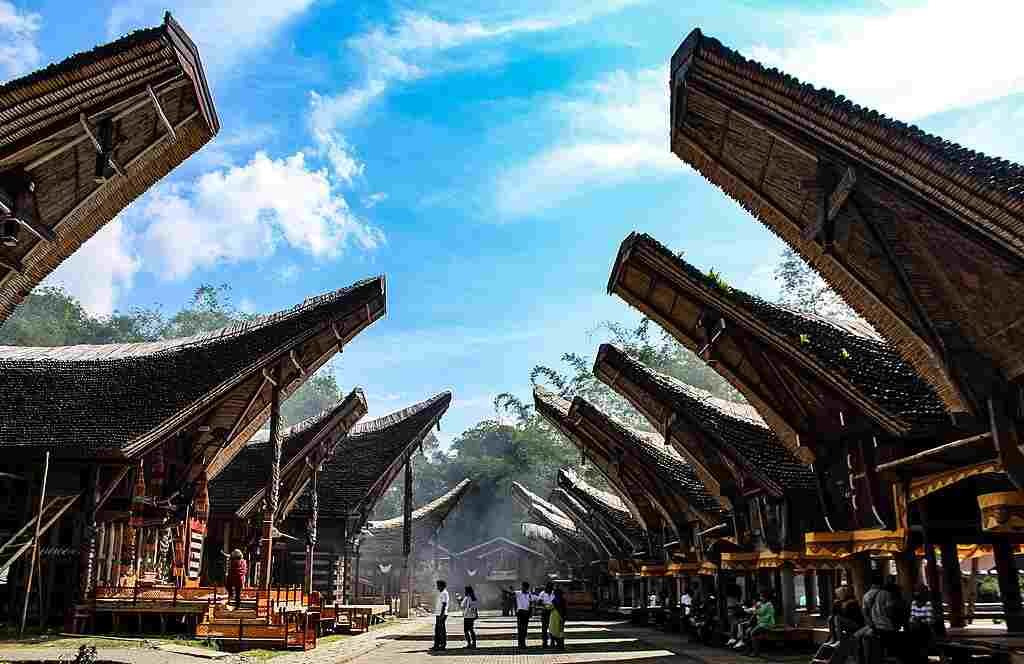
One of the most striking symbols of Toraja culture is the Tongkonan, the ancestral house with a dramatically curved roof that resembles a boat. These traditional houses are not simple homes: they are markers of lineage, inheritance, and family prestige.
A second responsive video section replacing broken Wikimedia visuals with a stronger travel view.
From Bali to Tana Toraja by plane
Best route from Bali to Tana Toraja
- DPS → Makassar (UPG): around 1 hour 20 minutes
- Makassar (UPG) → Toraja Airport (TRT): around 55 minutes
- Toraja Airport (TRT) → Rantepao: around 1 hour 15 minutes by car
Total travel time varies widely with transit time. In practice, many travelers should expect a journey of around 7 to 9 hours door to door.
Example Bali to Tana Toraja flight options
- DPS → UPG → TRT
Flight time: approximately 2 hours 15 minutes excluding transit. Then about 1 hour 15 minutes by car to Rantepao. - DPS → UPG → LLO (Palopo)
Flight time: around 2 hours 20 minutes excluding transit, then about 4 hours by road to Tana Toraja. - DPS → CGK → UPG → TRT
Longer but sometimes useful depending on schedules. - DPS → UPG then overland to Rantepao
Fast to Makassar by air, then about 9 hours by road to Tana Toraja.
Airlines for Bali to South Sulawesi routes
How to get to Toraja by bus or car
The main tourism base in Toraja is Rantepao. If you arrive in Makassar or from other parts of Sulawesi, overland travel is possible:
| Route | Approximate duration | Indicative budget |
|---|---|---|
| Makassar → Rantepao | 9 hours | IDR 200,000 |
| Tentena → Rantepao | 13 hours | IDR 180,000 |
| Ampana → Rantepao | 17 hours | IDR 250,000 |
| Manado → Rantepao | 26 hours | IDR 600,000 |
Travel tips for the road
- Night buses can be very cold because of strong air conditioning. Bring long pants, socks, and a sweater.
- A private minivan is more flexible, but night buses are often more comfortable than expected for long-distance travel.
- The overland route from Makassar is scenic, with rice terraces, Bugis villages, and mountain views.
Strong points of Tana Toraja
- Traditional villages and Tongkonan houses
- Funerary caves, balconies, and Tau Tau effigies
- Mountain landscapes and rice terraces
- Animist-inspired beliefs and unforgettable funeral ceremonies
Things to do and see in Tana Toraja
1. Rantepao, the tourism base of Tana Toraja
Rantepao is the main base for discovering Tana Toraja. It is where many travelers sleep, organize day trips, hire guides, rent scooters, and arrange visits to traditional villages and burial sites.
The town itself is not huge, but it is practical and full of guesthouses, restaurants, coffee stops, local shops, and transport connections. Its market is one of the most interesting places in town. The daily market is colorful and lively, while the animal market is especially famous for buffalo trading.
Some buffalo are worth thousands of euros, and the rare albino or spotted ceremonial buffalo can reach astonishing prices.
Best time to visit Rantepao and Tana Toraja
Tana Toraja has a humid tropical climate with a rainy season roughly from November to April and a drier season from May to October. Many travelers prefer June to October.
2. Ke’te Kesu, one of the most iconic Toraja villages
Ke’te Kesu is one of the most famous cultural sites in Tana Toraja. It combines traditional Tongkonan houses, carved rice barns, ancient graves, hanging coffins, and a strong sense of ancestral history.
This village is often one of the first places travelers visit because it offers both architecture and burial culture in a single stop. It is also photogenic without losing its spiritual atmosphere.
3. Londa cliff tombs and cave cemetery
Londa is one of the best-known burial sites in Toraja country. Here, caves in the cliff serve as ancient repositories for coffins, bones, and family remains. Above the cave entrance, you can often see rows of Tau Tau, the carved wooden effigies representing the dead.
Londa is only about 6 km (3.7 miles) from Rantepao, and the drive is short. Inside the cave, conditions can be dark and narrow, so a guide and proper light source are strongly recommended.
Tau Tau figurines
Tau Tau are symbolic wooden statues placed near certain burial sites. Traditionally, they represented people of high status. Today they remain one of the most powerful visual symbols of Toraja culture.
4. Funeral sites and ceremonies
One of the most extraordinary reasons to visit Tana Toraja is the opportunity to better understand its funeral traditions. These ceremonies are complex social and spiritual events involving family networks, offerings, ritual speeches, and buffalo sacrifice.
If you want to attend a ceremony, a local guide is highly recommended, both for access and for understanding what you are seeing.
Lemo
Lemo is one of the largest and most famous cliff cemeteries in Tana Toraja. The wall is punctuated with burial chambers and Tau Tau balconies. It is one of the easiest major funeral sites to visit from Rantepao.
Bori Rante
Bori Rante is known for its megalithic stone complex, ceremonial ground, and funerary importance. It is a memorable stop if you want to understand the ritual landscape beyond the most photographed sites.
Lokomata
Lokomata is known for its huge burial rock, around 20 meters (65.6 ft) across, carved with graves.
Tampang Allo
Tampang Allo is another fascinating burial cave, often described as a former chiefs’ cemetery, with wooden coffins, bones, and effigies inside a more hidden cave setting.
5. Trekking in the Toraja highlands
Tana Toraja is not only about ceremonial culture. It is also a beautiful trekking region with mountain roads, terraced rice fields, villages, and valleys. Good trekking areas include:
- Lemo surroundings
- Makale and nearby funerary sites
- Batutumonga and the landscapes around it
- Palawa and the northern villages
- Mamasa region for those continuing farther
6. Traditional villages
- Ke’te Kesu: Tongkonan houses and burial site
- Palawa: classic Toraja village atmosphere
- Mamasa villages: a slightly different style of architecture
- Ballapeu and surroundings
7. Jesus Christ Blessing statue (Buntu Burake)
The Jesus Buntu Burake statue in Makale stands on a hill at about 1,700 meters (5,577 ft) above sea level. At around 40 meters (131 ft) tall, it is one of the tallest Jesus statues in the world and offers a beautiful panoramic view over the Toraja highlands.
8. Tilanga Natural Pool
Tilanga Natural Pool is a peaceful blue spring area near Makale and not far from Lemo. It is a good soft stop between heavier cultural visits and can add a more relaxed side to your Toraja itinerary.
Other best South Sulawesi places to visit
Makassar, the main city of South Sulawesi
Makassar is the main gateway city to South Sulawesi and often the first stop before continuing to Tana Toraja. It mixes urban life, coastal promenades, colonial history, and access to regional travel routes.
It takes about 1 hour 20 minutes to fly from Bali to Makassar.
- Fort Rotterdam
- Losari Beach
- Samalona Island
- Akkarena Beach
- Dome 99 Mosque
Lake Tempe and its floating houses
Lake Tempe is one of the most unusual places in South Sulawesi. It is famous for floating houses inhabited mainly by fishing families. The houses shift with the wind and water, creating a dreamlike atmosphere.
From Sengkang, you can hire a longboat to explore the floating settlement. A typical journey takes around an hour each way, and the experience is one of the most memorable in the region.
Taka Bonerate National Park (Selayar)
Taka Bonerate National Park lies in the Flores Sea south of Sulawesi and is famous for its huge atoll system, coral reefs, marine life, and diving opportunities. It is one of the most beautiful marine areas in Indonesia.
Selayar can be reached by air from Makassar in around 40 minutes, or by road and ferry in a much longer journey.
- Fresh seafood in Benteng
- Boat trips and snorkeling
- Mangroves and island scenery
- Traditional stilt-house villages nearby
Bantimurung-Bulusaraung National Park
North of Makassar, Bantimurung-Bulusaraung National Park combines karst landscapes, caves, lowland forest, butterflies, and the famous Bantimurung waterfall. It is a good extension if you want nature after Toraja culture.
The park is around 50 km (31 miles) north of Makassar, or about 1 hour by road, and around 20 km (12.4 miles) from the airport.
Helpful internal links for SEO and readers
- From Bali to Manado | Complete Guide to Visit Bunaken, North Sulawesi
- Must-See Places in Indonesia
- International Direct Flights to Bali
- From Bali to Jakarta
- From Bali to Komodo
Sources kept from your original direction:
PinterPandai,
CleverlySmart,
Lonely Planet,
Discover Your Indonesia,
Wonderful Indonesia,
UNESCO
Main photo credit: Rudyasho (CC BY 4.0)
via Wikimedia Commons.
Photo description: funeral ritual Rambu Solo in Tana Toraja.
Have you booked your villa in Seminyak center?
I need more information
Book Your Private Villa
Promotions
Located in Seminyak Center – Bali, Villa Carissa offers a private swimming pool and enclosed garden to guarantee your privacy.
Whether you’re traveling with family, friends, or on a romantic getaway, Villa Carissa in Seminyak center offers the perfect base for exploring Bali’s many attractions and enjoying a relaxing vacation.

Villa Carissa in Seminyak Center